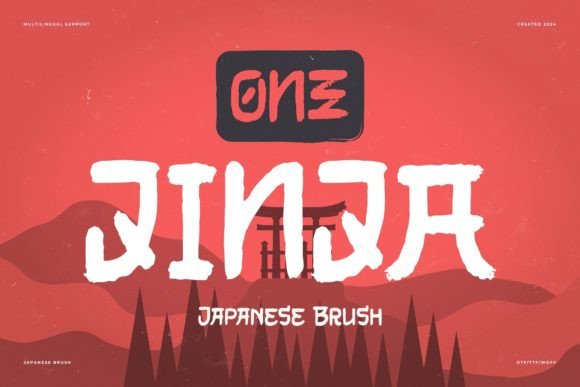
One Jinja: A Brush-Style Display Font for Handmade Charm
If you’ve ever held a handmade candle with a soft, inked label that felt like it belonged in a Kyoto studio—or admired an invitation where the couple’s names seemed to bloom from the page—you know how much a single font can elevate your craft. One Jinja is that kind of font: a Japanese brush-style display font designed to look authentically hand-brushed, with bold, expressive strokes and gentle, organic curves. It’s not just decorative—it carries warmth, intention, and quiet confidence. As someone who prints labels on kraft tags, cuts vinyl for farmhouse signs, and designs printable wedding suites for Etsy, I reach for One Jinja when I need beauty that doesn’t sacrifice clarity or commercial function.
What makes One Jinja stand out isn’t just its aesthetic—it’s how it behaves in real projects. The strokes are generous but controlled, so it holds up beautifully at 24pt on a greeting card or scaled down to 16pt on a product tag. It reads instantly as “handmade,” yet avoids the fragility some script fonts suffer from—no tiny hairlines that vanish in print or break on a Cricut blade. When I used it for a set of seasonal tea towel labels (think “Yuzu Ginger” and “Roasted Hojicha”), the letterforms stayed crisp even on textured cotton, and customers commented on how “thoughtful” the packaging felt.
For physical products, One Jinja shines in short, high-impact contexts: shop signage, boutique hang tags, ceramic mug decals, tote bag embroidery layouts, and engraved wooden coasters. Its rhythm invites pause—perfect for wedding welcome boards, baby shower banners, or artisanal soap wraps. I paired it with a clean sans serif (like Montserrat Light) for a line of botanical-printable planner pages: One Jinja handled titles and section headers while the sans carried body text and checkboxes. That contrast gave the design hierarchy *and* personality—exactly what buyers expect from premium digital downloads.
It’s also surprisingly versatile across seasons and styles. Last fall, I used One Jinja for a limited-run set of Halloween printable stickers (“Pumpkin Spice & Everything Nice”, “Witchy Hour”). The soft curves softened the theme without losing charm—and because the font includes standard OpenType features like ligatures and stylistic alternates, I could swap in a more delicate “&” or add subtle swash endings to “Nice” for extra flair. For spring, I layered it over watercolor backgrounds in SVG files for Silhouette users—its stroke weight translated cleanly through cut lines and print previews.
Readability matters most when scaling down. On 1” round stickers (like those for jam jars or bath bombs), I keep phrases to three words max—“Wild Lavender”, “Small Batch”, “Hand-Poured”—and avoid tight kerning adjustments that could blur in small sizes. For laser-cut wood signs or iron-on transfers, I always test print at actual size first; One Jinja’s consistent baseline and open counters mean it rarely needs manual tweaks before cutting. And yes—it works for non-Japanese text too. While rooted in Japanese calligraphy principles, One Jinja supports Latin characters with thoughtful spacing and proportional balance, making it safe for English product names, taglines, and social media graphics.
Pairing is intuitive. Think of One Jinja as your expressive anchor—then choose supporting typefaces that ground rather than compete. A warm, low-contrast serif like Playfair Display adds elegance without fuss. A friendly, rounded sans like Quicksand keeps things approachable for kids’ party printables. Or go minimalist: pair it with Inter or Lato for modern packaging where One Jinja handles the brand name and the sans carries ingredients or care instructions. Avoid pairing it with other high-contrast scripts—that’s visual noise, not harmony.
Before downloading, check what’s included. One Jinja typically ships as OTF and TTF files, with full multilingual support covering basic Latin, Japanese hiragana/katakana, and common punctuation. Some versions include bonus swash capitals and alternate lowercase forms—gold dust for designers building reusable template kits. If you’re creating SVG bundles for crafters, those alternates let buyers customize looks without needing design software.
Licensing is non-negotiable. One Jinja is a commercial font, meaning it’s fully cleared for use in physical products you sell (candles, mugs, apparel), digital downloads (PDF planners, Canva templates), client work (logo design, shop branding), and even merchandise made via print-on-demand services. Just verify the license covers your specific use case—especially if you’re bundling fonts into editable design assets or reselling pre-made SVG files. Most reputable sellers offer clear commercial terms, and using One Jinja ethically protects both your business and the designer’s craft.
In my own shop, One Jinja has become the quiet signature behind several bestsellers: a printable “Bloom & Gather” wedding suite, a set of minimalist ceramic studio tags, and a series of Japanese-inspired wall art prints featuring seasonal haiku. Customers don’t know the font name—but they feel its sincerity. That’s the power of a well-chosen display font. It doesn’t shout. It settles in, adds texture, and makes your handmade work feel seen, intentional, and deeply human.
Whether you're printing on recycled paper, cutting vinyl for a farmers’ market stall, or building a cohesive brand identity across stickers, packaging, and web graphics—One Jinja gives your work the quiet authority of true craftsmanship. Not flashy. Not fussy. Just beautifully, unmistakably made.